Last updated: April 2026
You can now buy and sell shares on the Nairobi Securities Exchange directly from your M-Pesa app using Ziidi Trader — no stockbroker account, no CDSC registration, and no minimum balance required. This guide walks you through the entire process, from activation to your first trade, including fees, tips, and everything a first-time investor needs to know.
Since launching in February 2026, Ziidi Trader has already captured roughly 40% of all trades on the Nairobi Securities Exchange and brought over 200,000 new investors into the market in a matter of weeks — a number that previously took the NSE nine years to reach through traditional channels.
If you have an M-Pesa account and KES 100 to spare, you can own shares in companies like Safaricom, Equity Bank, KCB, and dozens more — all from your phone.
What Is Ziidi Trader?
Ziidi Trader is a stock trading feature built directly into the M-Pesa app by Safaricom, in partnership with Kestrel Capital (a licensed stockbroker). It allows any registered M-Pesa user aged 18 or older to buy and sell shares listed on the Nairobi Securities Exchange (NSE) without needing a separate brokerage account or CDSC (Central Depository and Settlement Corporation) registration.
Think of it as the M-Pesa of stock trading — the same way M-Pesa made banking accessible to millions of Kenyans who didn’t have bank accounts, Ziidi Trader is doing the same thing for the stock market.
Your shares are held under an omnibus account managed by Kestrel Capital on your behalf. This means you don’t need to go through the traditional process of opening a CDSC account, visiting a stockbroker’s office, or filling out lengthy paperwork. Everything happens on your phone.
Ziidi Trader is regulated by the Capital Markets Authority (CMA) of Kenya, so your investments are protected under the same legal framework that governs all stock market activity in the country.
What You Need Before You Start
Before you can buy your first share on Ziidi Trader, make sure you have the following:
An active Safaricom M-Pesa account. You must be a registered M-Pesa user with a valid Safaricom line. If you already use M-Pesa for sending money, paying bills, or using Fuliza, you’re already set.
The M-Pesa app installed on your smartphone. Ziidi Trader is accessed through the M-Pesa super app, not through a separate download. Make sure your app is updated to the latest version from the Google Play Store or Apple App Store.
You must be 18 years or older. This is a regulatory requirement from the Capital Markets Authority. Minors cannot trade on the NSE.
Money in your M-Pesa wallet. You’ll need funds available in your M-Pesa balance to purchase shares. The minimum you can invest starts from as little as one share — which for some NSE-listed companies can cost as little as KES 1 to KES 5 per share.
A valid national ID. Your M-Pesa account is already linked to your ID, so no additional verification documents are needed.
How to Activate Ziidi Trader on M-Pesa (Step-by-Step)
Setting up Ziidi Trader takes less than five minutes. Here’s exactly how to do it:
Step 1: Open the M-Pesa App Launch the M-Pesa app on your smartphone and log in using your M-Pesa PIN. Make sure you’re connected to the internet (mobile data or WiFi).
Step 2: Navigate to Financial Services On the M-Pesa home screen, look for the “Financial Services” section. This is the same area where you’d find services like Ziidi (money market fund), M-Shwari, and KCB M-Pesa.
Step 3: Select Ziidi Trader Under Financial Services, tap on “Ziidi Trader.” If you don’t see it, update your M-Pesa app to the latest version — the feature was rolled out in February 2026 and may require an app update on older versions.
Step 4: Accept Terms and Conditions You’ll be presented with the platform’s terms of service, risk disclosures, and Kestrel Capital’s service agreement. Read through these carefully — they cover important details about how your shares are held, trading rules, and your rights as an investor. Tap “Accept” to proceed.
Step 5: Complete Verification Confirm your identity using your M-Pesa PIN. Since your M-Pesa account is already KYC-verified (linked to your national ID), there’s no additional paperwork. The system verifies your details automatically.
Step 6: You’re Ready to Trade Once verification is complete, you’ll land on the Ziidi Trader dashboard. From here, you can browse available stocks, view market data, set up watchlists, and place your first trade.
The entire process — from opening the app to being ready to buy shares — takes about 2 to 3 minutes.
How to Buy Shares on Ziidi Trader (Step-by-Step)
Now for the part you’ve been waiting for — actually buying shares. Here’s the exact process:
Step 1: Open Ziidi Trader and Tap “Trade” From the Ziidi Trader dashboard, tap the “Trade” button to enter the trading screen.
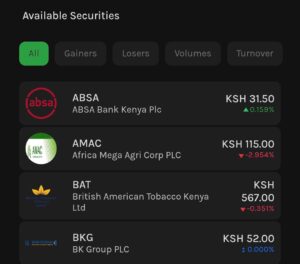
Step 2: Select the Company You Want to Invest In Browse the list of available NSE-listed companies or use the search function to find a specific stock. You’ll see companies like Safaricom (SCOM), Equity Group (EQTY), KCB Group (KCB), East African Breweries (EABL), KenGen (KEGN), and many more.
Each listing shows the current share price, the day’s price movement (up or down), and trading volume.
Step 3: Tap “Buy” Once you’ve selected your stock, tap the “Buy” button to start placing your order.
Step 4: Choose Your Pricing Option Ziidi Trader gives you two ways to price your purchase:
- Best Price: This automatically buys shares at the lowest price currently available from sellers on the NSE. This is the simplest option and recommended for beginners — you get the best deal the market is offering right now.
- Own Price: This lets you set a specific price you’re willing to pay per share. If a seller matches your price, the trade goes through. If not, the order stays open until 3:00 PM (market close) and then expires. This option is for investors who want more control over their entry price.
If you’re new to investing, start with “Best Price.” It’s faster, simpler, and ensures your order is likely to be filled immediately during market hours.
Step 5: Enter the Number of Shares Type in how many shares you want to buy. You can buy as few as one single share — there’s no minimum quantity requirement. The app will show you the total cost based on the current price multiplied by the number of shares.
Step 6: Review Your Trade Summary Before confirming, Ziidi Trader shows you a complete summary of your order: the company name, number of shares, price per share, total cost, and any applicable fees. Double-check everything.
Step 7: Confirm with Your M-Pesa PIN Tap “Buy Shares,” then “Proceed,” then “Buy Shares” again, and finally enter your M-Pesa PIN to authorize the payment. The funds are deducted from your M-Pesa wallet instantly.
Step 8: Trade Confirmation You’ll receive a confirmation notification once your trade is executed. The shares are now held in your Ziidi Trader portfolio, and you can view them anytime from the dashboard.
That’s it. You just bought shares on the Nairobi Securities Exchange from your phone.
How to Sell Shares on Ziidi Trader
Selling shares follows a similar process:
- Open Ziidi Trader and go to your portfolio
- Select the shares you want to sell
- Tap “Sell”
- Choose “Best Price” (sells at the highest price buyers are currently offering) or “Own Price” (set your own asking price)
- Enter the number of shares to sell
- Review the trade summary
- Confirm with your M-Pesa PIN
Once the sale is executed, the proceeds (minus fees) are deposited directly back into your M-Pesa wallet. No waiting for bank transfers or broker payouts.
Ziidi Trader Fees and Charges Explained
Understanding the costs is essential before you start trading. Here’s what you’ll pay:
Trading Fees
Ziidi Trader charges approximately 1.5% per trade as an all-in fee. This single fee bundles together the typical costs that traditional brokers charge separately, including brokerage commission, NSE transaction levy, CMA levy, CDSC fees, and stamp duty.
For comparison, traditional stockbrokers in Kenya typically charge between 1.8% and 2.5% per trade when you add up all the individual fees. Ziidi Trader’s bundled rate saves you money on every transaction.
Deposit and Withdrawal Fees
Zero. There are no charges for moving money between your M-Pesa wallet and your Ziidi Trader account. Deposits are free, and when you sell shares or withdraw funds, the money goes back to your M-Pesa at no extra cost.
Example Trade Calculation
Let’s say you want to buy 100 shares of Safaricom at KES 30 per share:
| Item | Amount |
|---|---|
| Share price | KES 30.00 |
| Number of shares | 100 |
| Subtotal | KES 3,000.00 |
| Trading fee (~1.5%) | ~KES 45.00 |
| Total cost | ~KES 3,045.00 |
With a traditional broker, the same trade would cost you roughly KES 3,054 to KES 3,075 (at 1.8%–2.5%), plus you’d likely need a minimum account balance of KES 5,000–10,000 just to open the brokerage account.
Ziidi Trader Trading Hours and Rules
There are a few important rules to understand about how trading works on the platform:
Market hours: The Nairobi Securities Exchange is open Monday to Friday, from 9:30 AM to 3:00 PM East Africa Time. You can browse stocks and plan trades outside these hours, but actual buying and selling only happens when the market is open.
Good Till Day orders: All orders on Ziidi Trader are “Good Till Day,” which means they’re only valid for the current trading day. If your order isn’t filled by 3:00 PM, it automatically expires and any funds held for the order are reversed back to your M-Pesa wallet. You won’t lose money on unfilled orders.
Daily transaction limit: M-Pesa’s daily transaction limit of KES 500,000 applies to Ziidi Trader as well. If you need to make larger investments, you’ll need to spread them across multiple days or consider opening a traditional brokerage account.
Settlement: Share trades on the NSE follow the T+3 settlement cycle, meaning it takes three business days after a trade for the shares to officially transfer. However, your Ziidi Trader portfolio reflects the purchase immediately.
What Shares Can You Buy on Ziidi Trader?
Ziidi Trader gives you access to all shares listed on the Nairobi Securities Exchange. As of 2026, this includes over 60 companies across various sectors. Here are some of the most popular stocks among Kenyan retail investors. For a deeper analysis of which ones are worth buying, see our top 10 NSE stocks to buy in Kenya for beginners.
| Company | Ticker | Sector |
|---|---|---|
| Safaricom PLC | SCOM | Telecommunications |
| Equity Group Holdings | EQTY | Banking |
| KCB Group | KCB | Banking |
| East African Breweries | EABL | Manufacturing |
| KenGen | KEGN | Energy |
| Kenya Power (KPLC) | KPLC | Energy |
| Co-operative Bank | COOP | Banking |
| Absa Bank Kenya | ABSA | Banking |
| BAT Kenya | BAT | Manufacturing |
| Stanbic Holdings | CFC | Banking |
Beyond shares, Ziidi Trader also lets you invest in corporate bonds listed on the NSE, which gives you an additional way to diversify your portfolio without leaving the platform.
Ziidi Trader vs Traditional Stockbrokers: Which Is Better?
If you’re wondering whether to use Ziidi Trader or go with a traditional stockbroker, here’s an honest comparison:
| Feature | Ziidi Trader | Traditional Broker |
|---|---|---|
| Account opening | 2–3 minutes on M-Pesa | Days to weeks (CDSC + broker paperwork) |
| Minimum investment | 1 share (as low as KES 1) | Typically KES 5,000–10,000 minimum |
| Trading fees | ~1.5% all-in | 1.8%–2.5% combined |
| Deposit/withdrawal fees | Free via M-Pesa | Bank transfer fees may apply |
| CDSC account required | No (omnibus account) | Yes |
| Portfolio access | 24/7 on M-Pesa app | Broker’s portal (varies) |
| Corporate bonds | Yes | Yes |
| IPO applications | Not yet available | Yes |
| Margin trading | No | Some brokers offer this |
| Share transfer to CDSC | Not currently supported | Full CDSC ownership |
| Customer support | Safaricom + Kestrel Capital | Dedicated relationship manager |
The verdict: Ziidi Trader is ideal for beginners and casual investors who want simplicity, low costs, and the convenience of trading from M-Pesa. Traditional brokers are better for serious investors who need advanced features like IPO access, margin trading, or direct CDSC ownership of their shares.
Many investors use both — Ziidi Trader for quick, small trades and a traditional broker for larger, long-term holdings.
Important Things to Know Before Investing
Buying shares is exciting, but it’s important to go in with realistic expectations. Here are a few things every first-time investor should understand:
Shares can go down in value. Unlike money market funds (like Ziidi MMF) where your money earns predictable interest, share prices fluctuate daily based on market conditions. You can lose money if you sell shares at a lower price than you bought them. Never invest money you can’t afford to lose.
Investing is a long-term game. The most successful investors on the NSE are those who buy quality shares and hold them for years, not days. Short-term price movements are unpredictable, but historically, the Kenyan stock market has rewarded patient investors.
Diversify your investments. Don’t put all your money into a single company’s shares. Spread your investment across different companies and sectors to reduce your risk. A good starting point is to own shares in at least 3 to 5 different companies.
Do your research before buying. Don’t buy a share just because someone on social media or WhatsApp told you to. Look at the company’s financial results, dividend history, and business outlook. If you don’t understand what a company does or how it makes money, don’t invest in it yet.
Dividends are a source of income. Many NSE-listed companies pay dividends — a portion of their profits distributed to shareholders. Some popular dividend-paying stocks include Safaricom, Equity Bank, KCB, and BAT Kenya. Dividends are paid into your Ziidi Trader account automatically.
Frequently Asked Questions About Ziidi Trader
Is Ziidi Trader safe? Yes. Ziidi Trader is operated by Safaricom in partnership with Kestrel Capital, a licensed stockbroker regulated by the Capital Markets Authority (CMA) of Kenya. Your shares are held in a custodial account and are legally yours. The platform operates under the same regulatory framework that governs all NSE trading.
Do I need a CDSC account to use Ziidi Trader? No. Ziidi Trader uses an omnibus account structure managed by Kestrel Capital. This means your shares are held on your behalf without needing a personal CDSC account. However, this also means you cannot transfer shares bought on Ziidi Trader to a traditional CDSC account (or vice versa) at this time.
What is the minimum amount I can invest? You can buy as little as one share. The actual cost depends on the share price of the company — some NSE stocks cost as little as KES 1–5 per share, while others like Safaricom are around KES 25–35 per share (as of early 2026).
Can I buy shares outside market hours? You can browse stocks and set up orders anytime, but trades are only executed during NSE market hours: Monday to Friday, 9:30 AM to 3:00 PM. Orders placed outside market hours will be queued for the next trading session.
What happens if my order isn’t filled? All Ziidi Trader orders are “Good Till Day.” If your order isn’t matched by a seller (or buyer, if you’re selling) by 3:00 PM, it expires automatically and your funds are returned to your M-Pesa wallet at no charge.
Can I apply for IPOs through Ziidi Trader? As of April 2026, IPO applications are not available through Ziidi Trader. For upcoming IPOs, you’ll need to apply through a traditional stockbroker or directly through the issuing company’s IPO channels. This may change as the platform evolves.
How do I receive dividends? Dividends from shares held on Ziidi Trader are paid directly into your Ziidi Trader account. From there, you can withdraw them to your M-Pesa wallet at no cost.
*Can I use Ziidi Trader on USSD (334#)? No. Ziidi Trader is only available through the M-Pesa smartphone app. It is not accessible via the USSD menu (*334#) or M-Pesa on SIM Toolkit. You need a smartphone with the M-Pesa app installed.
Is there a daily limit on how much I can invest? Yes. Since Ziidi Trader uses M-Pesa for transactions, the M-Pesa daily transaction limit of KES 500,000 applies. For larger investments, consider spreading purchases across multiple days or using a traditional broker.
Your First Trade: A Practical Example
Let’s walk through a real scenario so you can see exactly what the experience looks like.
Scenario: You want to buy 50 shares of Equity Group Holdings (EQTY), currently trading at KES 55 per share.
- Open the M-Pesa app and navigate to Ziidi Trader
- Tap “Trade” and search for “Equity Group” or “EQTY”
- Tap on Equity Group Holdings, then tap “Buy”
- Select “Best Price” for the simplest experience
- Enter 50 as the number of shares
- The app shows: 50 shares × KES 55 = KES 2,750, plus approximately KES 41 in fees
- Total deduction from your M-Pesa: approximately KES 2,791
- Tap “Buy Shares,” confirm with your M-Pesa PIN
- Done — you now own 50 shares of one of East Africa’s largest banks
Your shares appear in your Ziidi Trader portfolio immediately, and you’ll earn dividends whenever Equity Group declares them (typically twice a year).
Tips for Getting the Most Out of Ziidi Trader
Start small and learn. Buy a few shares of one company first. Get comfortable with how the platform works, how prices move, and how buying and selling feels before committing larger amounts.
Use the watchlist feature. Ziidi Trader lets you create personalized watchlists to track stocks you’re interested in. Add companies you want to monitor and watch their prices over a few weeks before buying.
Set up price alerts. Enable real-time price alerts so you know when a stock hits a price you’re interested in. This is especially useful if you’re using the “Own Price” option and want to buy at a specific level.
Invest regularly, not all at once. Instead of putting a large sum in one go, consider investing a smaller amount every week or month. Our guide on how to start investing in Kenya with just KSh 1,000 shows you exactly how. This strategy (called “shilling cost averaging”) helps you avoid buying everything at a peak price.
Reinvest your dividends. When you receive dividends, use them to buy more shares. Over time, this compounding effect significantly grows your portfolio.
Keep learning. The stock market rewards informed investors. Follow NSE market news, read company annual reports, and understand the basics of how to evaluate a stock. The more you know, the better your investment decisions will be.
What’s Next After Ziidi Trader?
Once you’re comfortable trading on Ziidi Trader and your portfolio grows, you might want to explore additional investment options available to Kenyan investors:
Money Market Funds (MMFs): For the portion of your money you want to keep safe and liquid while earning interest, consider a money market fund. See our complete comparison of the best money market funds in Kenya to find the right one — we cover Ziidi MMF, Britam, Sanlam, Gulfcap, Mansa X, and more.
Government Bonds: The Central Bank of Kenya offers infrastructure bonds and treasury bills through the M-Akiba platform, starting from as little as KES 3,000.
Real Estate Investment Trusts (REITs): Listed on the NSE, REITs let you invest in property without buying an actual building. The ILAM Fahari I-REIT is currently available.
Insurance and Pension: As your wealth grows, protecting it becomes just as important as growing it. Look into NSSF voluntary contributions, personal pension plans, and insurance products.
Building wealth is not about picking one investment — it’s about building a diversified portfolio that works together. For a broader overview of all the ways to buy shares in Kenya (including traditional brokers), read our complete guide to buying shares in Kenya. Ziidi Trader is an excellent starting point, and as your knowledge and capital grow, you can expand into these other areas.
This guide is for educational purposes only and does not constitute financial advice. All investments carry risk, including the potential loss of principal. Always do your own research before investing. Share prices and fees mentioned are approximate and may change. Verify current information on the official Safaricom and NSE platforms before making investment decisions.
Related articles you might find useful:
- How to Open a CDSC Account in Kenya
- Best Money Market Funds in Kenya — Full Comparison (2026)
- Best Shares to Buy on the NSE Right Now
- Ziidi MMF Review: Is It Worth It?
- How the Nairobi Securities Exchange Works — A Beginner’s Guide
Disclaimer: The content on Sarafu is for educational and informational purposes only. It does not constitute financial, investment, or professional advice. All investments carry risk — the value of your investments can go down as well as up, and you may receive back less than you invest. Always do your own research and consider consulting a licensed financial advisor before making any investment decisions. Past performance is not a guarantee of future results.

Educative, thanks.